
Multi-Asset Portfolio Construction
A portfolio framework connecting geopolitical and macroeconomic scenarios to allocation decisions across asset classes
I developed this portfolio as an independent project to test how geopolitical, macro, and financial market views can be translated into deliberate asset allocation choices. As an investment thesis designed for a hypothetical UK university endowment, it provides a comprehensive approach to portfolio construction, supported by a multi-layered risk management framework.
Problem
The portfolio was constructed against the early January 2026 backdrop: persistent inflation, uncertain interest rate expectations, and a volatile geopolitical context. The core challenge was to build a portfolio that was aligned with a CPI + 4% return objective, annual spending needs, perpetual investment horizon, sustainability and exclusion-related considerations. In addition, the portfolio needed to be resilient across a range of geopolitical and macroeconomic scenarios, including outcomes that differed significantly from prevailing market expectations at the time of portfolio construction.
Objective
To construct a multi-asset portfolio for a hypothetical £1 billion UK university endowment, translating geopolitical, macro and financial market views into a portfolio across public and private assets.
Approach
I approached the portfolio construction process with the view that financial markets rarely operate in a vacuum from geopolitical and macroeconomic dynamics. Both play a pivotal role in shaping risk premia, capital flows, valuations and asset performance, particularly in today’s investment environment.
Taking the client profile as a starting point, I built the portfolio within a standard institutional structure, while applying a first-principles decision-making approach. The distinguishing feature of this approach was an explicit integration of geopolitical factors as primary inputs into asset allocation decisions, rather than being treated as background commentary.
On this basis, I developed a top-down view of the forces most likely to shape the investment landscape and translated them into a portfolio structure in which each asset served a clear strategic purpose. The resulting portfolio spans fixed income, equities, and alternatives. Each asset allocation decision was assessed across four dimensions: its function and benefits within the portfolio, as well as the potential risks with the corresponding risk management approach.
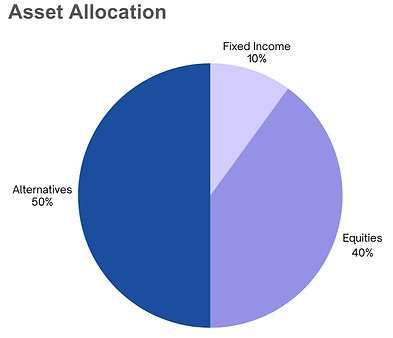
Result
The result was a hypothetical comprehensive investment proposal, with an evidence-based rationale for each allocation, grounded in geopolitical and macro considerations.
At the same time, the project served a broader purpose: not only to construct a multi-asset portfolio for a hypothetical endowment client, but also to develop the structured decision-making framework behind it.
While the portfolio itself follows a standard endowment structure, the framework is differentiated by the consistent use of geopolitical factors as core inputs into asset-allocation decisions. It is this translation of external uncertainty into specific portfolio choices that gives the project its first-principles character.
The iterative component of the process relied on conducting data-driven risk-return analysis in Excel, evaluating the weighted contribution of each asset to overall portfolio outcomes. This enabled me to refine the allocation and optimise asset weights to better align with the client profile and objectives. I then supplemented this evaluation with a qualitative assessment of how the portfolio would likely behave across base, bull and bear cases.
This framework not only outlines the proposed asset allocation, but also the reasoning and judgement underpinning the asset choices, allocation weightings, cross-asset interactions and trade-offs required to align with the client profile.
HERE is the first-principles decision-making framework, showing the analytical process behind the portfolio construction.
***Detailed investment content of the portfolio is not included, as this type of financial material is not appropriate for public release, given the legal and regulatory considerations involved.